Invisible Hurdles Program
In 2015 Hume Riverina Community Legal Service (HRCLS) launched a four-way integrated partnership with Albury Wodonga Aboriginal Health Service (AWAHS), North East Support and Action for Youth (NESAY), and Wodonga Flexible Learning Centre to create better legal outcomes for young people experiencing, or at risk of, family violence in North East Victoria.
Overcoming the Invisible Hurdles to Justice for Young People Project (Invisible Hurdles Program), is codesigned by young people and provides early intervention through integrated service delivery.
Lawyers provide legal advice, assistance, education and information to young people who are supported by non-legal professionals. Education is delivered in engaging and meaningful ways – over 200 education sessions have been delivered in 10 years on topics selected by young people. These sessions have included court visits, mock trials, attending voting booths, visiting legal offices, even a tenancy Q&A with a chocolate house!
Lawyers also provide legal information, secondary consultations and professional development training to non-legal professionals to build community capacity.
This holistic approach to service delivery supports young people to overcome the invisible hurdles to justice that can compound legal issues, disadvantage and affect wellbeing. The Invisible Hurdles Program makes lasting change for individuals, families and communities.
Embedded research methodology and evaluation by Dr Liz Curran is a key feature of the Invisible Hurdles Program, with proxies used to measure impact and success.
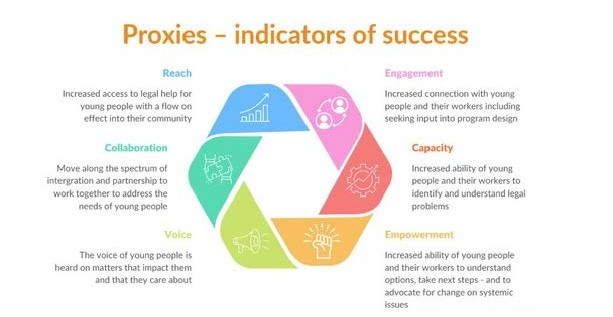
Dr Liz Curran has found:
“The data suggests that the program has been effective in making inroads in responding to family violence occurring in the lives of young people and their families.”
“The data from Stage III of the research evaluation, is suggestive that the program is not only having an impact on justice outcomes but is also flowing through to effect issues around recovery, hope, improved informed decision making, and improvements in income, housing, and social and service connection (namely the social determinants of health).”
The Invisible Hurdles Program is a blueprint for reaching young people affected by family violence and interrupting the cycle of disadvantage through the provision of legal assistance in partnership with education, health, and homelessness services.
“We know that for most young people experiencing disadvantage, seeking out legal help will be low on their list of priorities…the project makes lawyers accessible and allows them to build trust with young people who have been so burned throughout their lives that trust comes slowly.”
Liana Buchanan, Victorian Commissioner for Children and Young People, May 2017
Stage I, II & III Reports
Overcoming the Invisible Hurdles to Justice for Young People – Invisible Hurdles Final Report 2018
Invisible Hurdles Final Report 2018 – Executive Summary
Invisible Hurdles Stage II – innovative project continues to deliver
‘Going Deeper’ IH Stage III Research Evaluation Report
Webinar
Accessing the support we need: Health Justice Partnerships and systems change – hosted by Day Four Projects April 2022 – Conversation with a health justice partnership (the HALO HJP) between Gateway Health and HRCLS, and the national centre for excellence in HJPs – Health Justice Australia
International media coverage
Pathways to Empowerment – Nottingham Law School
Funding for 2022 delivery
Successful grant will propel effective legal project for young people experiencing family violence
Info sheets
What is the Invisible Hurdles Project?
Invisible Hurdles Stage II Report Summary/Findings
Helping Ellie get rid of large debt to help her get on with her life